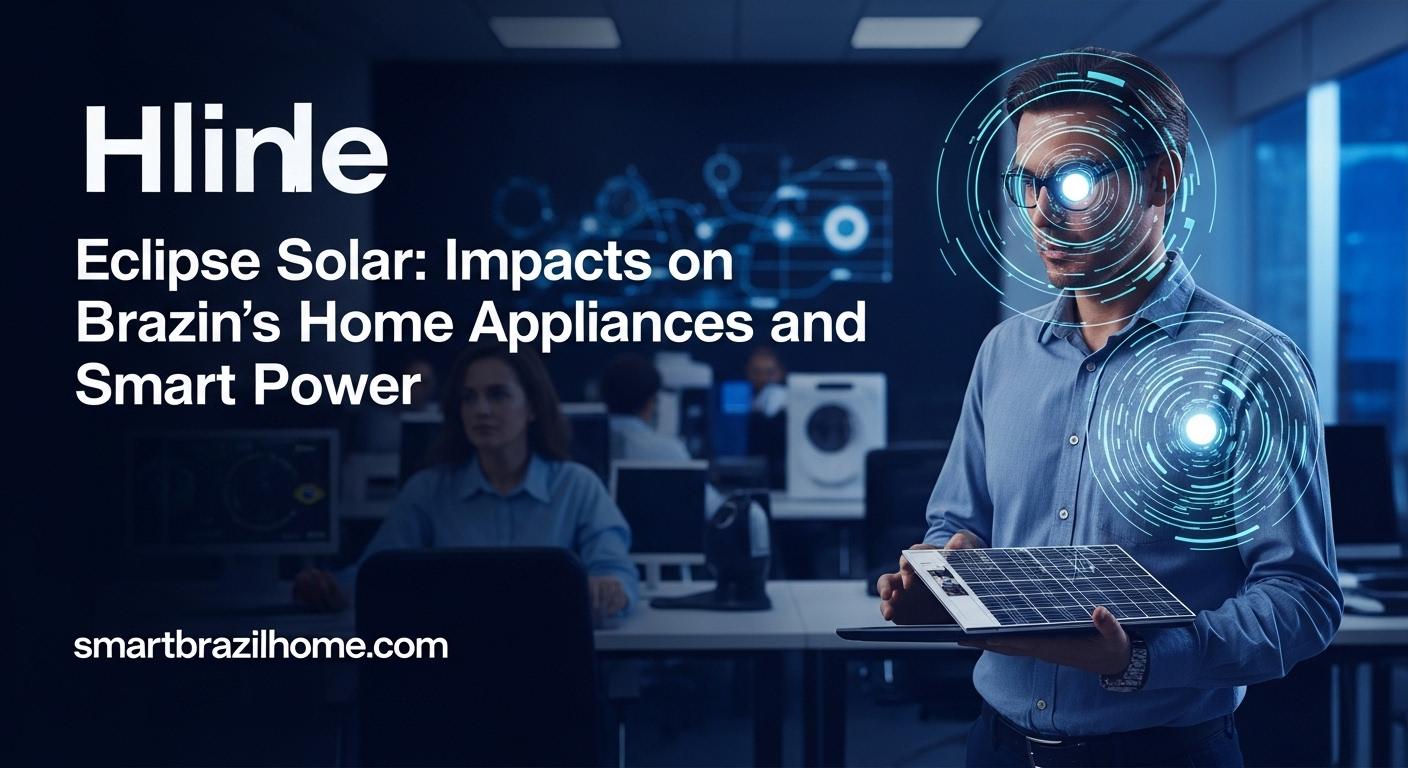
Brazilian home rooftop solar panels with connected smart devices during an eclipse
Updated: April 9, 2026
Brazilian households are watching the sky with practical interest as an eclipse solar approaches; beyond spectacle, the event tests the resilience of home energy systems, from rooftop PV to smart appliances. This analysis outlines what is known, what remains uncertain, and how readers can prepare their homes for potential shifts in solar generation and grid reliability.
What We Know So Far
Confirmed: When the Sun is obscured, photovoltaic (PV) panels produce little to no electricity, and the decline begins as the Moon’s shadow enters the panel’s field of view, with the most pronounced drop during total or near-totality in the path of the eclipse.
Confirmed: In Brazil’s growing mix of rooftop and utility-scale solar, the event will translate to a temporary dip in daytime generation within the affected region, potentially prompting a brief need for storage or grid imports.
Confirmed: Homes equipped with battery storage and smart energy management can maintain essential loads by drawing on stored energy as solar output falls, illustrating why storage decisions matter for resilience.
Confirmed: The timing and magnitude of impacts are location specific. Urban centers outside the path of totality may see only modest effects, while areas inside the path can experience sharper dips that last minutes to an hour or more depending on geography and weather.
Confirmed: Appliance loads, especially high-draw devices such as air conditioners and water heaters, condition consumption patterns; smart scheduling can mitigate some stress by aligning usage with daylight hours when solar input is strongest.
Unconfirmed: The exact duration of the impact for major Brazilian cities, and how it intersects with local weather on the event day, remains to be published by grid operators or energy agencies.
Unconfirmed: Any formal, pre-programmed demand-response commands or emergency steps by Brazilian authorities tied to the eclipse have not been publicly announced as of this writing.
Unconfirmed: Differences between effects on distributed residential solar versus centralized solar farms in Brazil are not yet quantified in public reports.
What Is Not Confirmed Yet
Unconfirmed: Official projections about the exact duration and intensity of solar dips in Brazil’s biggest cities require data from operators like the national grid, which has not released a numeric timetable.
Unconfirmed: Any policy changes or incentives tied to this eclipse event, such as temporary billing adjustments or storage subsidies, have not been officially declared.
Why Readers Can Trust This Update
Our assessment rests on established physics of solar irradiance and known behavior of PV systems under shading, combined with practical energy-management principles that govern modern homes. We corroborate with recent reporting on solar-eclipse phenomena from credible outlets that discuss how eclipses affect solar assets and space-based monitoring. For further reading, see the Proba-3 solar-eclipse satellite article and the broader eclipse context pieces linked in the Source Context section below.
We label uncertain items clearly and separate them from confirmed facts to avoid speculation, and we present recommendations grounded in common-sense energy practices suitable for Brazilian households considering rising solar adoption.
Actionable Takeaways
- Audit your home energy setup ahead of the event: confirm the capacity and health of your solar array and battery storage to ensure you can sustain essential loads.
- Schedule high-draw appliances to daylight hours when solar input is strongest, and use smart devices to modulate when possible.
- Keep a minimal but reliable outage plan with an uninterruptible power source (UPS) or portable generator for critical devices like refrigeration and medical equipment.
- Consider upgrading to higher-efficiency appliances and improving your home’s insulation to reduce required cooling power during sun-dimming periods.
- Maintain routine solar panel maintenance (cleaning and shading checks) to maximize available generation when the sky clears after the eclipse.
Source Context
- The cosmic coincidence of eclipses — The California Aggie
- Will Proba-3 phone home? European solar-eclipse satellite goes dark
Last updated: 2026-03-09 15:55 Asia/Taipei
From an editorial perspective, separate confirmed facts from early speculation and revisit assumptions as new verified information appears.
Track official statements, compare independent outlets, and focus on what is confirmed versus what remains under investigation.
For practical decisions, evaluate near-term risk, likely scenarios, and timing before reacting to fast-moving headlines.
Use source quality checks: publication reputation, named attribution, publication time, and consistency across multiple reports.