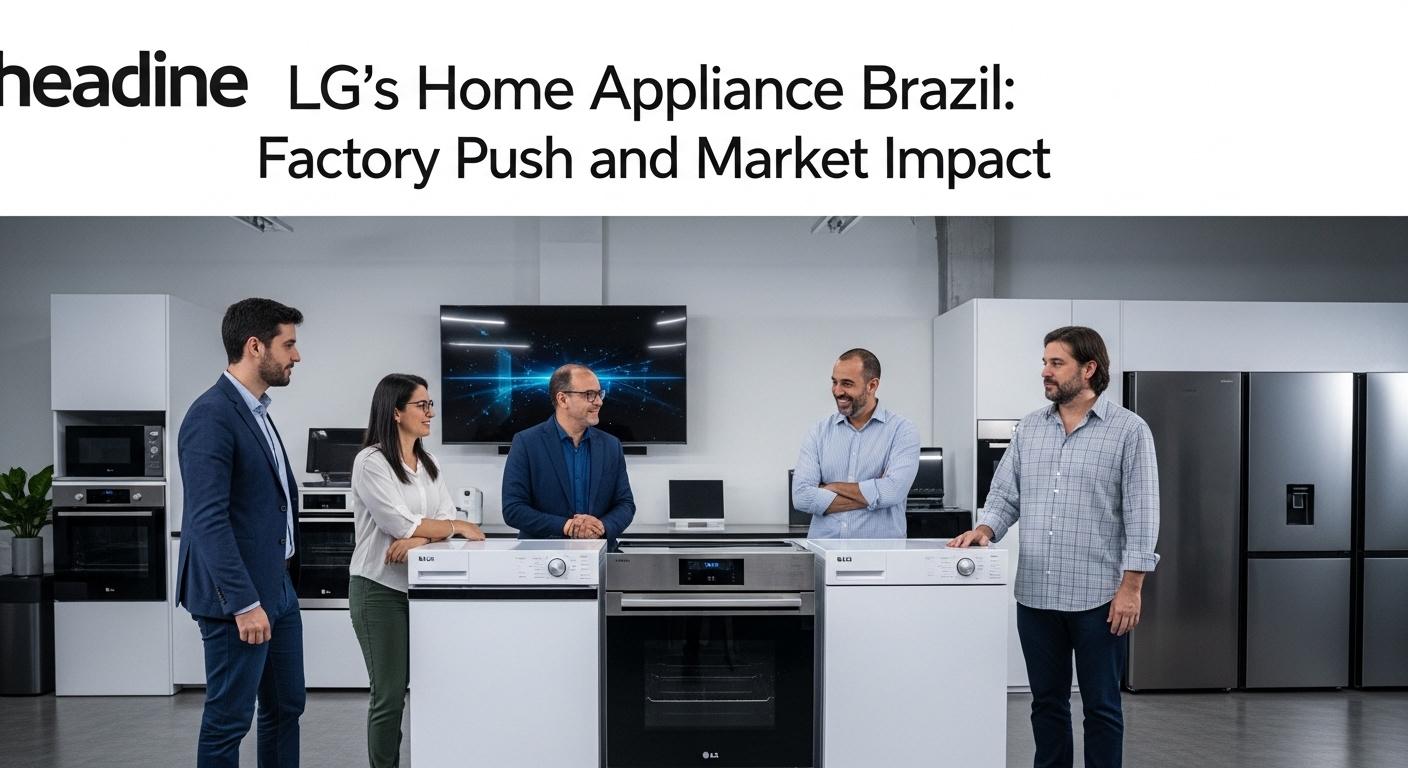
LG factory in Brazil with workers assembling refrigerators, signaling local manufacturing impact.
Updated: April 9, 2026
lg’s Home Appliances Brazil has emerged as a focal point in Brazil’s consumer-electronics scene, not only for a BRL 1.5 billion factory but for what it signals about LG’s approach to local production, pricing, and employment.
Market Context and Investment
Brazil’s home-appliance market has long balanced between imported goods and locally assembled products, shaped by inflation, currency swings, and policy shifts. The reported plan for a 770 m² facility, backed by a BRL 1.5 billion investment, positions LG to shift part of its supply chain closer to Brazilian households. If the numbers hold—that the operation will yield about 500 refrigerators per year and support roughly 1,000 jobs—the announcement moves beyond a single plant and into a broader debate about how multinational manufacturers finance growth in emergent markets and how much of that investment translates into domestic capacity. In this context, the target market size of around BRL 16.4 billion annually provides a rough yardstick for demand. The project also invites questions about local sourcing rules, skilled-labor training, and how Brazilian consumers might benefit from shorter lead times and potentially more stable pricing, at least for core refrigerator lines.
Manufacturing Strategy and Jobs
The footprint of 770 square meters described in early coverage invites scrutiny. Even if the yardstick is symbolic or reflects a staged expansion, the promise of 1,000 jobs underlines a deliberate shift toward a domestically anchored footprint. For LG, the strategy seems to combine assembly with regional supply partners, offering opportunities to transfer manufacturing know-how and to cultivate a local service network that underpins after-sales support. Analysts note that achieving consistent output of 500 refrigerators per year will depend on efficient production planning, vendor reliability, and the ability to scale in response to Brazilian demand cycles. The scenario also carries risk: if import costs ease or currency volatility shifts, the cost advantage of domestic assembly may erode; if labor costs rise or automation penetrates more deeply, the number of permanent roles could be affected. The balance between human labor and automation will shape not only this plant’s short-term performance but the longer-term profitability of LG’s Home Appliances Brazil strategy.
Consumer Impact and Pricing
From a consumer perspective, local manufacturing can translate into shorter supply lines, quicker restocking, and greater resilience against global shocks. Yet price outcomes depend on a matrix of variables, including raw-material costs, energy prices, transport, and the exchange-rate environment that affects imported components. If the factory’s output scales as planned, LG could channel some procurement through domestic suppliers, potentially dampening price volatility and broadening access to key refrigerator models. However, the net effect on Brazilian households will hinge on whether savings from localization are passed through and whether competition from both local and international players intensifies price discipline across the segment. Retail channels will play a crucial role in translating factory capacity into consumer choice, especially as financing options, warranties, and service quality influence perceived value in a price-sensitive market.
Sustainability and After-Sales
Beyond the factory floor, the arrangement raises questions about energy efficiency, repairability, and the scale of after-sales networks. In markets such as Brazil, where consumer trust in service infrastructure can drive purchasing decisions, LG’s ability to deliver reliable maintenance, replacement parts, and timely repairs may determine the practical value of new models for families and small businesses. A durable domestic network also supports compliance with evolving environmental standards, including refrigerant handling and waste-management practices. If LG couples its manufacturing push with investments in local training for technicians, it can bolster market confidence and accelerate the adoption of newer, more energy-efficient appliances, which in turn reinforces the case for localization as a long-run competitive strategy.
Actionable Takeaways
- Policy makers: evaluate targeted incentives that encourage domestic assembly while ensuring fair competition and consumer protections.
- LG and suppliers: invest in local skills development and supplier-capability programs to sustain quality and resilience in the Brazilian market.
- Retailers: align inventory and financing options with the anticipated cadence of local production and service capacity to meet consumer demand.
- Consumers: monitor pricing trends and service availability to assess real benefits from localization and to favor models with robust warranties and parts networks.
- Market analysts: track capacity utilization, supply-chain diversification, and exchange-rate effects to gauge the lasting impact on Brazil’s appliance sector.